How Much Is One Minute of Line Stoppage Worth? After Running the Numbers, Many Factories Took a Fresh Look at the Splicing Process
Nov 27, 2026Many factories calculate splicing cost by asking, "How much does one person cost per month?"
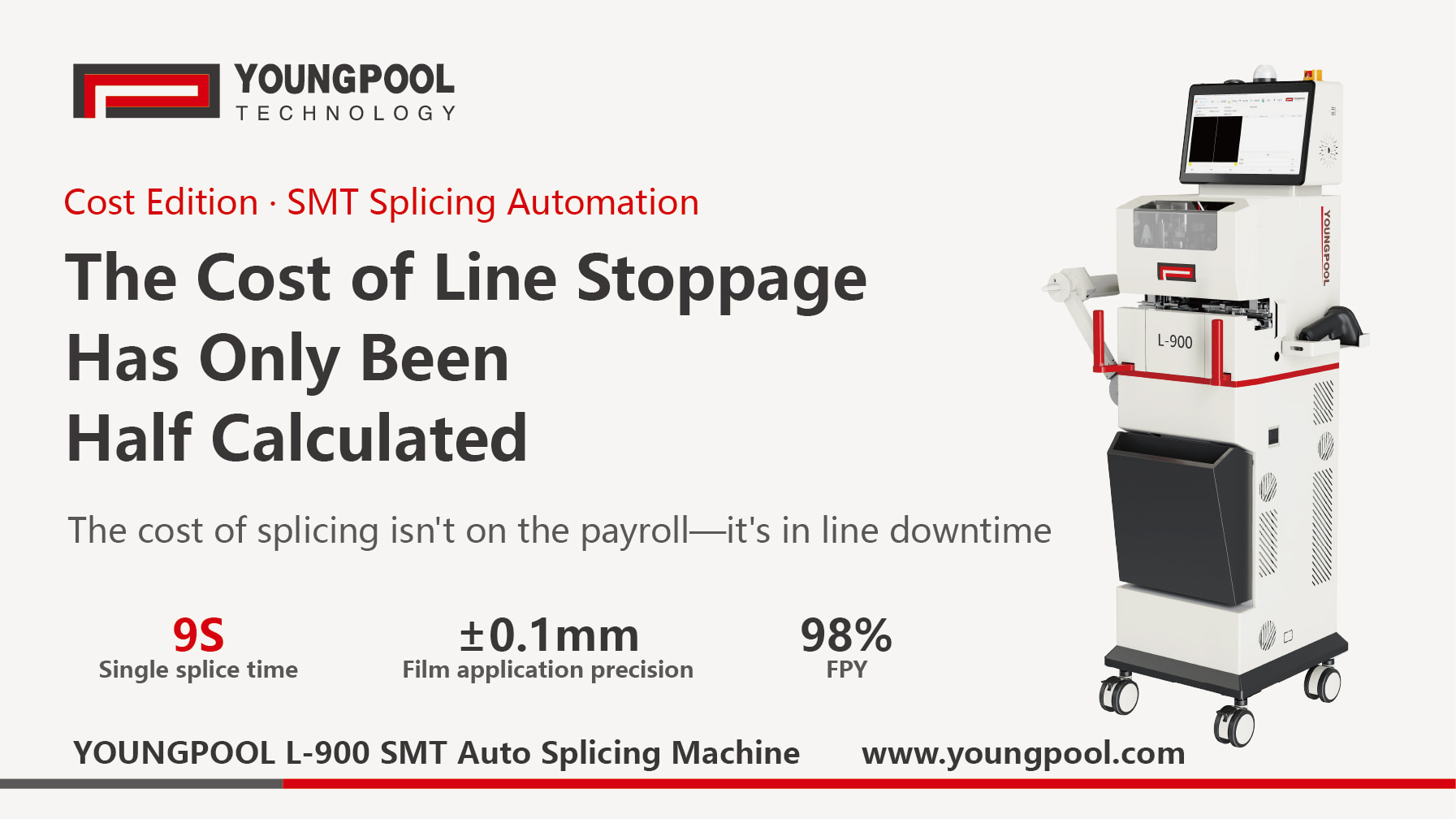
That calculation isn't wrong—it's only half the story. The other half is hidden in line downtime, and it has grown more expensive over the past decade.
I. Three Numbers Rising Together Make Splicing More Expensive
Pick-and-place machine cycle rates have risen: a decade ago, a few dozen components per hour; today, mainstream lines exceed one hundred.
Single-board value has risen: boards carry more components, and more expensive ones.
Reel change frequency has risen: with high-mix, low-volume production, a line changing material a dozen times a day is not unusual.
With all three numbers rising together, the cost center of splicing has shifted from "people" to "the line."
II. A Formula That's Good Enough
Line stoppage minutes × output per minute × single-board processing value.
For a line producing 100 boards per hour with a single-board processing value of 20 yuan, 10 minutes of stoppage costs about 330 yuan; at twice a day, 26 days a month, that's about 17,000 yuan.
This doesn't even count jam handling, first-article re-confirmation, or overtime caused by delivery schedule compression.
III. The Real Weakness of Manual Splicing Isn't Slowness—It's Instability
The same person: 3 minutes on a good day, 8 minutes on a bad day; new hires need re-inspection every time for the first three months.
Worse still, problems surface only after the splice goes onto the machine: a 0.2 mm seam offset, a lifted cover tape edge—the pick-and-place machine alarms at the splice point, and handling it takes another ten minutes or more.
The cost of manual splicing isn't a straight line—it's a curve with spikes. And production scheduling is built on "predictability."
IV. When It Pays Off
If line stoppage or re-inspection occurs two or three times a day, or if material is changed more than ten times a day—manual costs have most likely crossed the equipment amortization line.
For a small line that changes material only two or three times a day, manual splicing is more flexible, and equipment isn't necessary.
Equipment isn't "more advanced"—it's an arithmetic problem.
Splicing is a small matter; line stoppage is big money. It's just that these two things have never been on the same report.
If you're also struggling to explain the cost of this process, start by logging line stoppages for two weeks—data is more persuasive than any proposal.
About Youngpool Technology
Shenzhen Youngpool Technology has been deeply engaged in electronic manufacturing equipment for 20 years. Its products cover three series and eight product lines: carrier tape category—splicing machines, reel merging machines, reel splitting machines, and reel inspection machines; laser category—laser marking machines, laser depaneling machines, and dry ultrasonic cleaning machines; dispensing category—vacuum degassing machines. With "ease of use, reliability, and intelligence" as its design principles, the company provides equipment and process solutions for electronic manufacturing enterprises.
Consultation Hotline: 13640950259 (WeChat same number) | www.youngpool.com


 IPv6 네트워크 지원