Youngpool Technology | Why More and More SMT Factories Are Adopting Intelligent Splicing Machines

Aug 31, 2026

During the SMT production process, pick-and-place machines need to operate continuously at high speed, while material supply must keep pace with the production cycle. When the components on a reel are about to run out, operators need to promptly perform reel replacement or tape splicing. Otherwise, an interruption in material supply may affect the continuous operation of the pick-and-place machine. As electronics manufacturing moves toward high-mix, low-volume production, the number of product models and material types continues to increase, resulting in more frequent material changes on production lines. What may appear to be a simple splicing task has gradually become an important process affecting operator efficiency, material management, and production continuity under high-frequency, repetitive production conditions.


Disadvantages of Traditional Manual Splicing

Traditional manual splicing typically involves multiple steps, including material retrieval, barcode scanning, cutting off the empty tape, tape alignment, applying splice tape, pressing, rewinding, and more. The entire process relies to some extent on operator proficiency, and differences between operators may lead to variations in operating speed, tape alignment accuracy, and splice quality. When production lines require frequent material changes, the large amount of repetitive splicing work not only increases the workload for operators but also makes splicing efficiency and consistency more susceptible to human factors.


More importantly, in high-mix production environments, splicing is no longer simply a matter of joining two reels of carrier tape together.Whether the materials match, whether the splice position is accurate, whether the spliced tape can pass smoothly through the feeder, and whether material information such as LCR measurement results and marking verification can be completed in a timely manner all have a direct impact on subsequent production. Therefore, what SMT production lines need is not simply a faster way to complete a single splice, but a way to gradually standardize operations that previously depended on manual experience and integrate splicing with material verification, quality control, and production management.


Youngpool Technology L-900 Intelligent Splicing Machine: Bringing Splicing from Manual Operation to Process Standardization

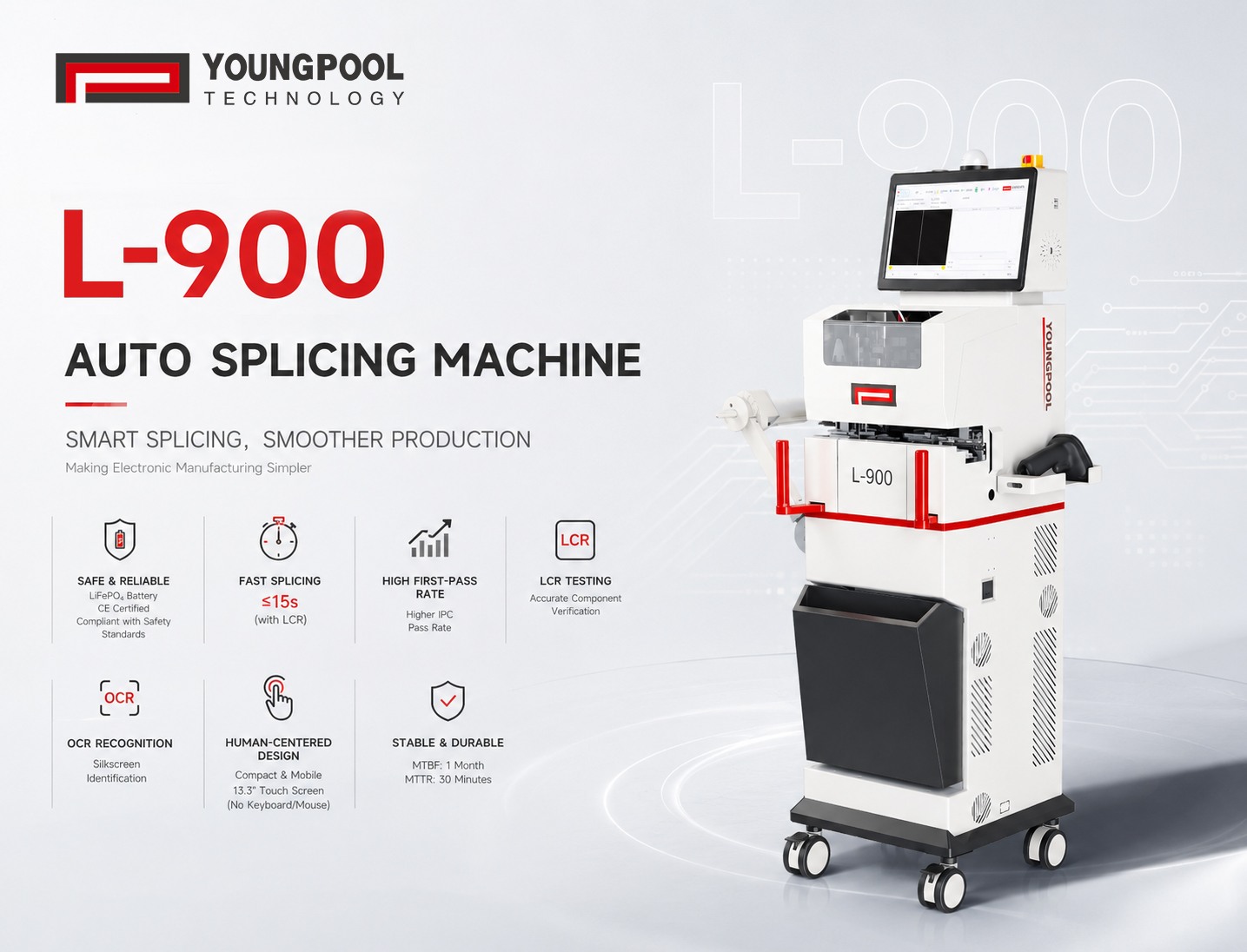
To meet the demand for high-frequency tape splicing on SMT production lines, Youngpool Technology has independently developed the **L-900 Intelligent Splicing Machine**, which is compatible with 824 mm paper and plastic carrier tapes and covers most commonly used tape specifications on SMT production lines. The machine uses automatic positioning and heat-press bonding technology to complete the splicing process, integrating previously separate manual operations into a unified machine workflow and reducing repetitive manual work.


Building on this, the L-900 Intelligent Splicing Machine can also integrate functions such as **LCR testing, marking recognition, material barcode error-proofing, and customized MES integration** according to the requirements of different production lines. For example, in applications requiring component LCR verification, traditional manual processes generally require additional sampling, measurement, and recording. The L-900 Intelligent Splicing Machine can integrate measurement into the splicing process, reducing repetitive operations between different process steps. Material barcode error-proofing and marking recognition provide additional means of material verification during the splicing process.


Application Value of the Youngpool Technology L-900 Intelligent Splicing Machine

For an SMT production line, completing the splice is not the end of the process. Whether the spliced tape can reliably enter the subsequent production process is equally important. The L-900 Intelligent Splicing Machine completes splicing through automatic positioning and heat-press bonding, while using a proprietary splice-film application solution. For tapes 12 mm and wider, a secondary film application process can be used to enhance the splice strength and better accommodate subsequent feeder operation, allowing the spliced tape to enter the pick-and-place machine's material feeding process more reliably.


At the same time, the machine integrates positioning, pressing, inspection, and error-proofing into the splicing workflow, reducing differences in operating methods among different operators. For high-mix production, this process standardization not only reduces repetitive manual work but also helps minimize the uncertainty caused by human judgment.


For SMT factories, adopting intelligent splicing equipment is not simply about completely replacing manual labor with machines. Rather, it provides a more stable solution for splicing operations that are frequent, repetitive, and highly standardized. By progressively integrating splicing, material verification, inspection, and data management, previously fragmented operations can be transformed into a clearer and more structured workflow.


This is particularly valuable in high-mix, low-volume production environments, where production lines may need to handle a large number of different materials and frequent material changes every day. The time required for a single splice, the quality of each splice, and the accuracy of each material verification may seem like minor details, but when repeated at high frequency, they can also affect the overall production rhythm. With support for customized MES integration, the L-900 can further incorporate splicingan operation that has traditionally been difficult to recordinto digital production management, providing a foundation for subsequent data traceability and production management.


Efficiency improvements on SMT production lines do not always depend solely on major production equipment. As high-mix, low-volume manufacturing becomes the production model adopted by an increasing number of electronics manufacturers, high-frequency and repetitive basic processes such as tape splicing also need to gradually move from manual executiontoward process standardization.


The transition from manual splicing to intelligent splicing changes more than just the way operators work. It transforms tasks that previously relied on individual experience into a more standardized, stable, and manageable production process.


The **Youngpool Technology L-900 Intelligent Splicing Machine** was developed around the real-world requirements of high-frequency splicing on SMT production lines. By further integrating splicing with material inspection, error-proofing, and digital management, it enables this seemingly simple process to create greater potential for improving production efficiency, process consistency, and production management.

여기를 클릭하여 메시지를 남겨주세요

메시지를 남겨주세요
우리 제품에 관심이 있고 자세한 내용을 알고 싶다면 여기에 메시지를 남겨주세요. 최대한 빨리 회신해 드리겠습니다.

제품

whatsapp